By Sean Peoples
I think we can all agree that the word “bottom” can have a negative connotation. We’ve all heard the expression rock bottom, bottom of the barrel, and bottom of the heap. We’ve been told that anything at the bottom is second-rate, unrefined, and a kind of reject.
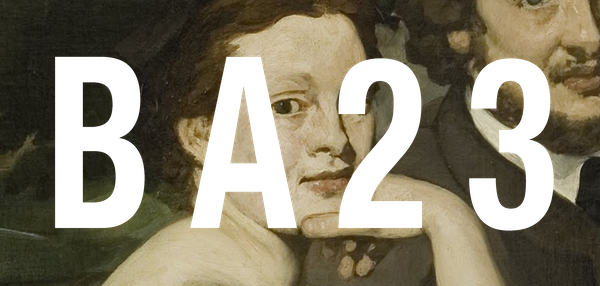
I noticed in the promotional material for the exhibition that a cropped image of Manet’s famous painting Luncheon on the Grass had been used. In Paris in the 1860s the only way to show your work as a budding artist was in the Paris Salon. Rejection from this exhibition was very bad news for an artist as it only came around once a year. When Manet first showed his painting to the Salon in 1863 they rejected it under the premise that it looked unfinished, the perspective was amateurish, and the subject matter was unsuitable for “great” art.
After some deliberation, Manet included his work in a different exhibition instead - a counter-offensive to The Salon called the Exhibition of Rejects.
The selection panel at the Salon were so beholden to the institution of the Salon that their experience of an artwork was entirely mediated through their selection criteria. Rather than grappling with the work head-on and acknowledging the work for what it was, they were bogged down by tradition. So bogged down that they missed out on championing what would become one of the most enduring and important foundations to what we now call Modernism.
I’m reminded of a wonderful essay I get my students to read every year by the art historian Linda Nochlin called “Why have there been no great women artists”. In it, Nochlin makes the extraordinary and controversial argument that for the most part there haven't been any great women artists because the way we think about greatness as a culture has traditionally excluded women. Nochlin has a problem with the question itself, and wants to critique the cultural biases implicit in it - that greatness tends towards those born into exceptional artistic and cultural moments. The greatness tends towards those with a means to support their careers. It tends towards those that aren’t required to care for children and families. And that it tends toward arts critics, historians, and curators who see THEIR values and ideals of beauty reflected.
If we get too comfortable and too rigid with our definition of greatness, or meditate our ideas of success through checkbox criteria we can miss out on a lot - way too much in fact - important work which has the potential to move us, engage us, and transform our lives.
Bottom Arts does what all great art does - it is a vehicle to imagine new possibilities and new ways of being in the world. It is a celebration of rejection. It is the autonomy and freedom that comes with forging your own path. It is an expression and desire to create community. It's a way of reframing a narrative by what we might mean by success.
Being at the top can be quite exhilarating, but perhaps we should be mindful not to spend too much time up there - it can get quite cold up there, the air can get a little thin, and the visibility can get a little hazy - and before you know it you've got elevation sickness.
Perhaps we should spend more time at the bottom. The bottom is where things are grounded in our immediate experiences - there is a kind of warmth down here where things have a real substance. At the bottom, we can be close to our friends and family. It's at the bottom that we can really get to the bottom of the matter.
Grab a glass and bottoms up!